

Wastewater Lab Report: 7 Costly Interpretation Mistakes to Avoid
Your wastewater lab report shows a chemical oxygen demand (COD) of 800 mg/L. Should you call the plant operator, question a supplier’s proposal or file the result as routine? Look at the sample label first. At the inlet, that number describes what your effluent treatment plant (ETP) received. At the outlet, it answers a different question. Without a location, it answers neither reliably.
Quick answer: Read the sample ID, collection period, units and laboratory notes before comparing results. Match concentrations to flow from the same period to estimate loads. For a discharge decision, use the sampling point and conditions specified for your site. Here is how those checks work on one factory report.
A worked example: reading a wastewater lab report
Illustrative figures only: This is a fictional extract, not Almasa project data or a table of UAE limits. Sample IN-01 is a flow-proportional composite collected at the ETP inlet over 24 hours. The operator’s meter recorded 50 m³ passing that point during those same hours.
| Parameter | Reported result |
|---|---|
| Chemical oxygen demand (COD) | 800 mg/L |
| Five-day biochemical oxygen demand (BOD₅) | 320 mg/L |
| Total suspended solids (TSS) | 150 mg/L |
| Total copper | <50 µg/L (laboratory reporting limit) |
1. Reading an inlet result as an outlet result
IN-01 tells the engineer what entered the ETP. It says nothing directly about the quality of water leaving it. The TSS figure of 150 mg/L, for example, describes incoming suspended material. It cannot establish that the clarifier is losing solids.
Match the sample ID to a marked point on the drainage drawing. “Factory wastewater” could mean a production drain, a mixed inlet or a final discharge chamber. If the description is ambiguous, confirm it with the sampler before placing the result on an outlet trend chart. This is the quickest check to make on any wastewater lab report.
2. Assuming the collection period covered the event
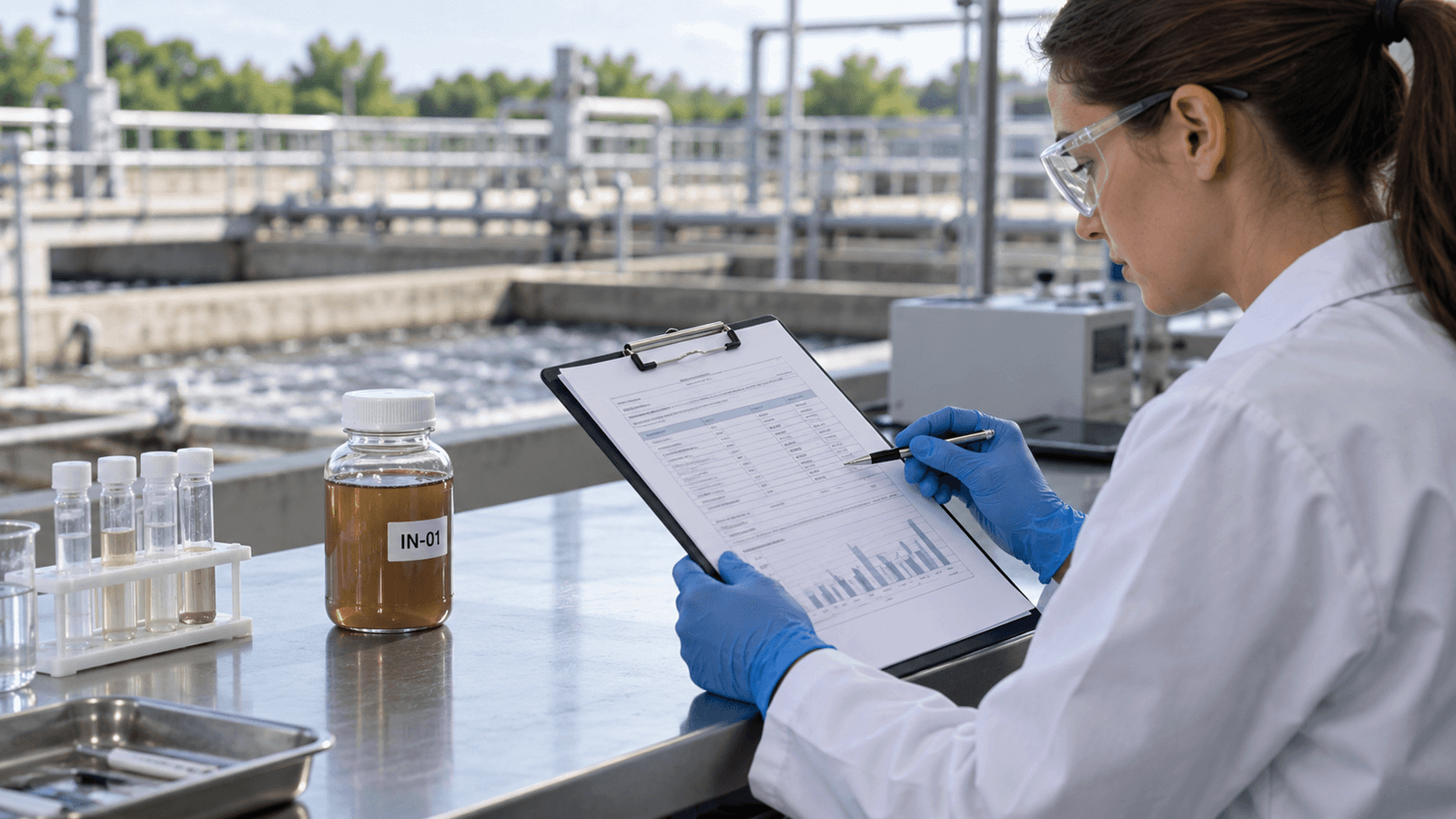
A composite represents the period collected. Suppose the factory ran its usual production during those 24 hours but cleaned a process tank the following morning. IN-01 can help describe the production day; it cannot explain an upset after that clean. Check collection start and finish times against the operator’s log, rather than using the date the laboratory issued the report.
Also check how each parameter was sampled. An average can conceal a short excursion, particularly for pH. The US EPA’s industrial sampling manual explains why sampling method matters. If you are investigating a peak, ask what measurements exist for the time of the event.
3. Comparing numbers without matching units or test fractions
The copper line uses micrograms per litre; the COD line uses milligrams per litre. Because 1 mg equals 1,000 µg, the copper entry converts to <0.050 mg/L. Keep the less-than sign when transferring it into a spreadsheet. Entering “50 mg/L” changes both the scale and the meaning.
Units alone are not enough. If last month’s wastewater lab report lists dissolved copper and this month’s lists total copper, a difference between the two values is not evidence of a change in production. Check whether the method and sample fraction match before plotting a trend.
4. Treating a less-than sign as zero
Here the laboratory has not reported a numerical copper concentration below 50 µg/L. That does not establish that copper is absent. The US Geological Survey’s explanation of reporting limits illustrates why laboratories distinguish quantified results from results below a threshold. Read the key on your own report: “ND”, an estimated value and a result below a reporting limit may have different meanings.
Suppose an engineer needs to distinguish concentrations above and below 20 µg/L for an internal investigation. The entry “<50 µg/L” cannot settle that question: 10 and 30 are both below 50. Ask the laboratory whether a more sensitive method is suitable. Neither example concentration is a discharge limit.
5. Using the BOD₅-to-COD ratio to select equipment
For IN-01, 320 divided by 800 gives a BOD₅-to-COD ratio of 0.40. BOD₅ measures oxygen demand over a five-day biological test. COD measures oxygen demand under chemical oxidation and can include oxidisable inorganic material. The EPA’s wastewater terminology guide explains the distinction.
The ratio gives an engineer a reason to investigate biological treatment. It does not mean a reactor will remove exactly 40% of the incoming COD. If a cleaning chemical might inhibit the biomass, identify the chemical and evaluate that concern separately before selecting a biological process.
6. Confusing concentration with daily load
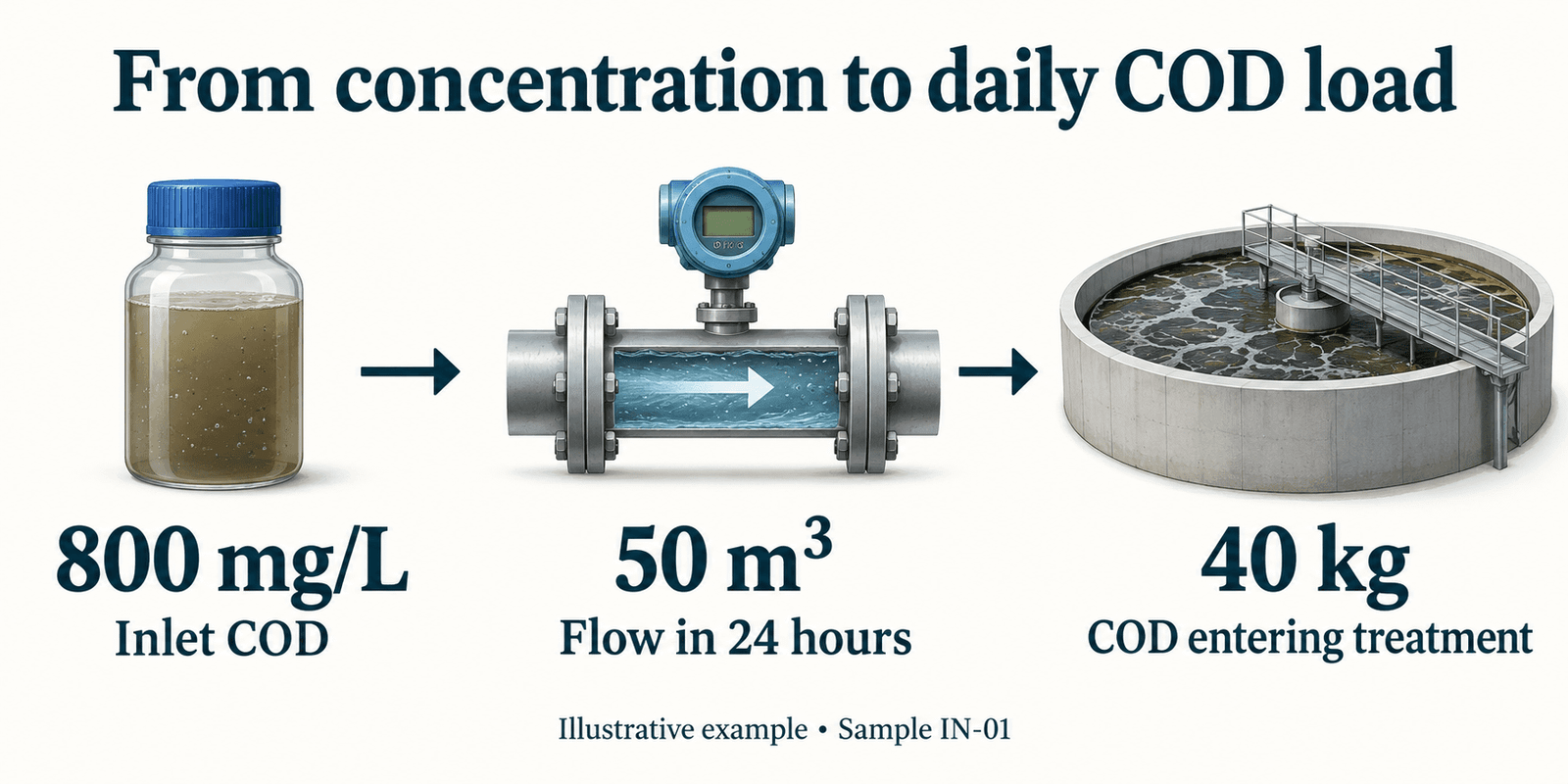
Pair the wastewater lab report with the inlet flow record. For this example, 800 mg/L × 50 m³ ÷ 1,000 = 40 kg of COD entering the ETP during the sampled day. At the same concentration, a day with 100 m³ of flow would bring in 80 kg. The operator could see an unchanged laboratory concentration while the plant receives twice the load.
Use a representative concentration and the volume passing the same point over the same period. Multiplying a grab sample from a concentrated batch by the whole factory’s daily flow can greatly overstate its contribution.
7. Applying the wrong discharge or reuse criteria
Before marking a wastewater lab report “pass” or “fail”, check the receiving route, authorised sample point, parameter, units and averaging period. Abu Dhabi’s Trade Effluent Control Regulations, section 6.2, for example, address representative sampling of discharge to the sewerage system. A sewer criterion from one jurisdiction does not establish suitability for irrigation or another reuse application.
For IN-01, the defensible conclusion is specific: the factory sent an estimated 40 kg of COD to treatment on the sampled day. Outlet compliance remains unknown. To discuss what your results mean for an industrial wastewater treatment project, send Almasa the complete report, sample-point drawing, matching flow record and intended outlet criteria. If those records are missing, start with our guide to planning industrial wastewater tests.