

MBR vs Conventional STP: Which Is the Best Choice for Industrial Projects in UAE?
Choosing the right sewage treatment plant (STP) technology is one of the most critical decisions for industrial facilities, construction sites, labour camps, and commercial developments in the UAE.
Two technologies dominate the market:
Conventional Activated Sludge STP
MBR (Membrane Bioreactor) Technology
But which one is truly better for UAE conditions?
This guide provides a complete technical and commercial comparison of MBR vs Conventional STP in UAE, helping you make the right decision for compliance, cost efficiency, and long-term reliability.
Why This Decision Matters in UAE
The UAE has:
Strict discharge standards
Limited land availability
High environmental enforcement
Growing water reuse demand
Increasing sustainability targets
A poorly selected STP can result in:
Repeated compliance issues
Odor complaints
High operational costs
Sludge management problems
System failure
This makes technology selection crucial.
What Is a Conventional STP?
A conventional Sewage Treatment Plant typically includes:
Equalization tank
Aeration tank
Secondary clarifier
Sludge return system
Chlorination
It relies on gravity settling to separate treated water from biological sludge.
Advantages of Conventional STP
Lower initial capital cost
Simple technology
Suitable for large, permanent land areas
Limitations in UAE Context
Large footprint
Moderate treated water quality
High sludge production
Odor risks
Requires tertiary filtration for reuse
What Is MBR Technology?
MBR (Membrane Bioreactor) combines:
Biological treatment
Membrane filtration (micro/ultrafiltration)
Instead of settling tanks, membranes physically separate solids from treated water.
This results in:
High-quality effluent
Compact design
Stable operation
MBR is now widely considered the best wastewater treatment technology in UAE for compact and high-performance applications.
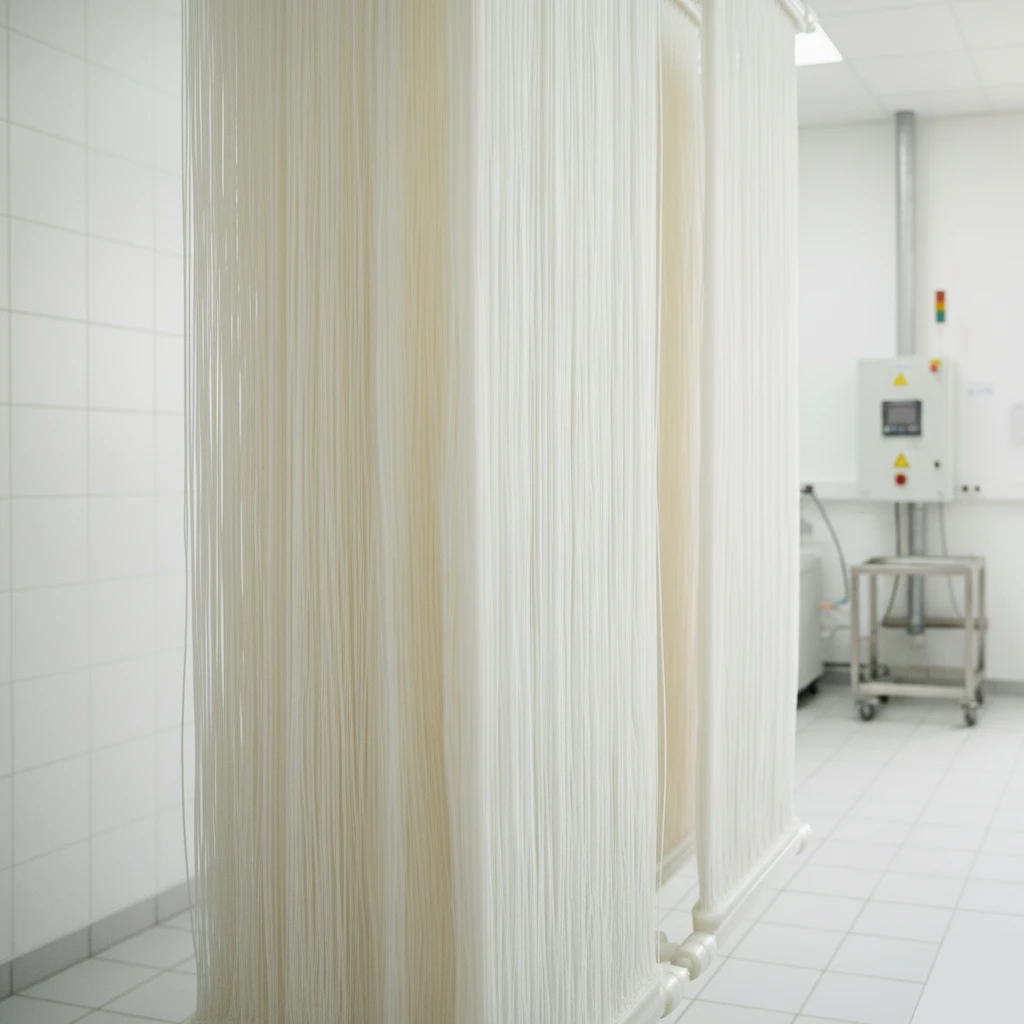
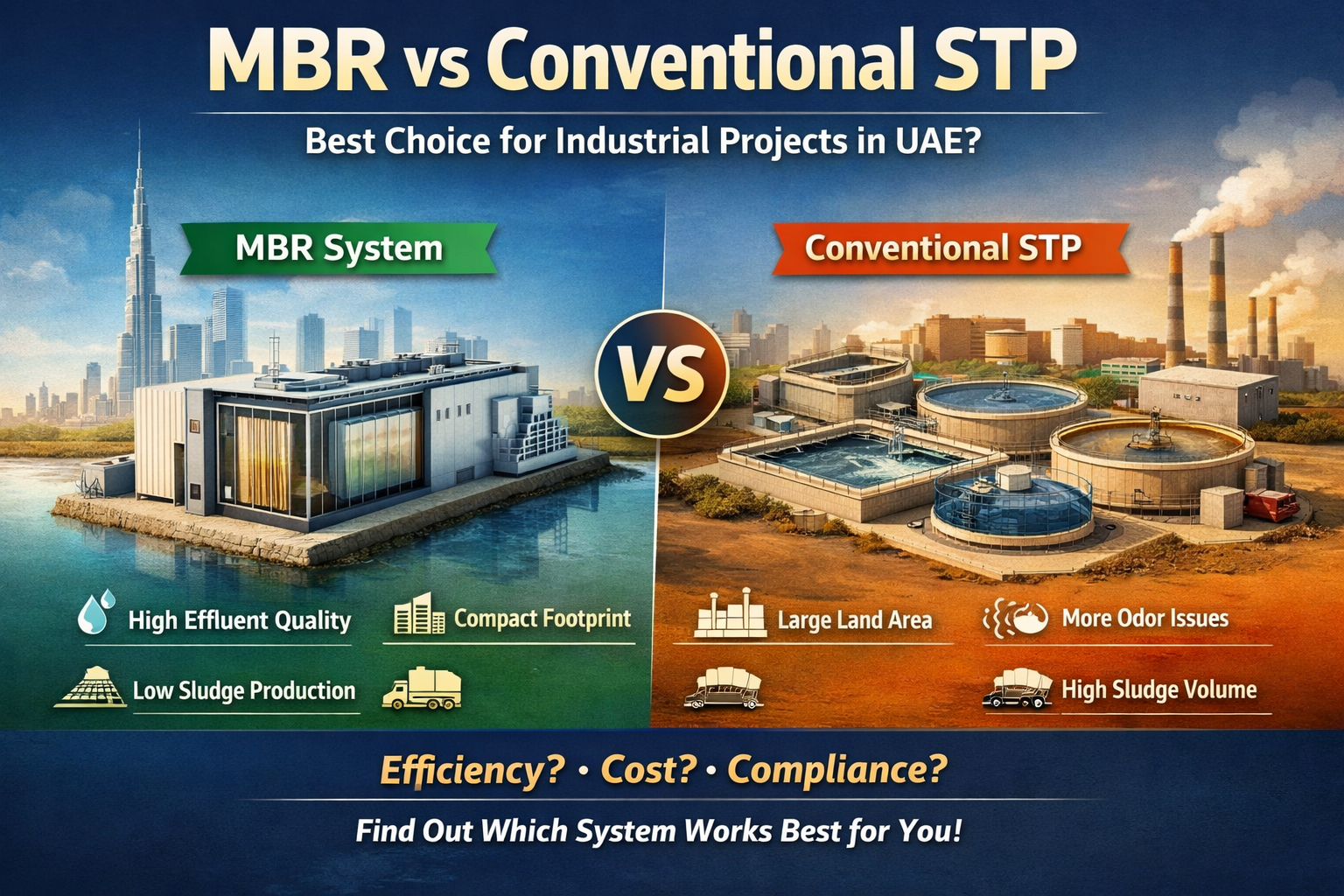
MBR vs Conventional STP: Side-by-Side Comparison
Footprint Requirement
Conventional STP:
Requires large area
Needs clarifiers and tertiary filters
MBR:
40–60% smaller footprint
No need for secondary clarifier
In UAE where land cost is high, MBR has a major advantage.
Treated Water Quality
Conventional STP:
BOD typically 20–30 mg/L
May require polishing
MBR:
BOD < 5 mg/L
TSS nearly zero
High pathogen removal
MBR-treated water is often suitable for:
Irrigation
Toilet flushing
Cooling towers
Industrial reuse
Odor Control
Conventional systems rely on open clarifiers.
MBR systems are typically enclosed and compact, reducing odor exposure.
This is crucial for:
Labour camps
Residential areas
Commercial properties
Sludge Production
Conventional systems generate more excess sludge.
MBR systems operate at higher biomass concentration, resulting in:
Lower sludge yield
Reduced disposal cost
Sludge handling is a major operational cost factor in UAE.
Energy Consumption
This is where debate often happens.
MBR systems require membrane aeration, which increases energy usage.
However:
Modern membrane technology reduces energy demand
Smart automation optimizes aeration
Reduced tertiary treatment offsets energy costs
In many industrial cases, lifecycle cost favors MBR.
Compliance Stability
Conventional STP effluent quality may fluctuate under:
Shock loading
Flow variation
Poor sludge settling
MBR provides stable filtration regardless of sludge characteristics.
For UAE regulatory compliance, this stability is critical.
Application-Based Recommendation
Construction & Labour Camps
Best Choice: MBR
Why?
Compact
Portable
High compliance reliability
Easy relocation
(Related: Wastewater Treatment for Construction & Labour Camps in UAE)
Industrial Facilities
Best Choice: Case-dependent
If:
Space is available
Discharge standards are moderate
Conventional may work.
If:
High-quality reuse required
Limited footprint
Strict compliance
MBR is better.
Commercial Developments & Hotels
Best Choice: MBR
Reasons:
Low odor
Small space requirement
Water reuse capability
Cost Comparison: CAPEX vs OPEX
Initial Cost (CAPEX)
Conventional STP:
Lower upfront cost
MBR:
Higher due to membranes
Operational Cost (OPEX)
Conventional:
Higher sludge disposal
Additional tertiary filtration
Higher risk of fines
MBR:
Lower sludge volume
Reduced chemical use
Stable compliance
Over 5–10 years, MBR often provides better lifecycle value.
Future Trends in UAE Wastewater Industry
The UAE is moving toward:
Water reuse
Sustainable infrastructure
Reduced carbon footprint
Compact modular plants
Smart monitoring systems
MBR aligns better with these long-term sustainability goals.
As water scarcity becomes more pressing, high-quality treated water reuse will become mandatory in many sectors.
Key Decision Factors Before Choosing
Ask these questions:
How much space is available?
Is water reuse required?
What are the discharge standards?
Is this a temporary or permanent facility?
What is the long-term operational budget?
How strict is regulatory enforcement in your area?
The right technology depends on project objectives not just initial price.
When Should You Upgrade to MBR?
You should consider upgrading if:
Your conventional STP struggles to meet standards
You experience frequent sludge bulking
You need better treated water quality
You plan to reuse water
Land availability is limited
MBR retrofitting is possible in many cases.